This is the second in a series of posts about historic travels.
The ancient Minoans were avid travelers, sailing from their base in Crete to various places around the eastern Mediterranean, from about 3000 to 1000 BC. We know this indirectly by evidence of the trade they conducted and artifacts they left in various places. Their coins have been found as far west as southern Italy and Sicily, and they may have even passed through the Strait of Gibaltar. But we have no direct written record of any particular voyage.
But we do have written record of one ancient voyager, named Ulysses. We have the story written by Homer, an epic voyage with a few detours, of Ulysses sailing home from Troy, “The Odyssey”. This story was put together from Greek stories, Minoan traditions, and myths from various peoples, handed down by word of mouth from generation to generation until Homer put them together and wrote them down. So it is not what we think of when we think of a traveler relating his experiences on a trip. There is no way to tell how much is true or based on truth and how much is pure fantasy. Homer knew little about geography or navigation, so there are many errors in these areas. But as a story of exploration and adventure, this one stands out.
I’m not going to give a synopsis of the book here. Nor am I going to try to trace the route of Ulysses on his journey, as this has been done many times, and all of the attempts have been based on conjecture and luck. But there are some places that we can determine as probable stops along the way.
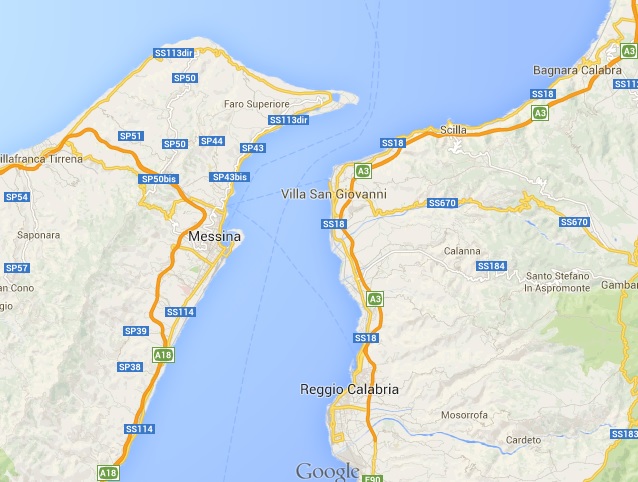
The “Scylla and Charybdis” almost certainly corresponds to the Strait of Messina between the island of Sicily and Calabria at the “toe” of Italy. The Scylla (a six headed serpent) is thought to correspond to a rock shoal on the Italian side of the strait and the Charybdis refers to a whirlpool off the coast of Sicily. Sailing between them could save considerable time as opposed to going around the island of Sicliy, but in those times it was a very big risk.
When Odysseus reached the Aeolian Islands, the Keeper of the Winds, gave Odysseus a tightly closed bag full of captured winds to use to easily sail home it Ithaca. However, his men opened it thinking it was full of riches, which ended up extending the voyage. The Aeolian Islands are located north of Sicily in the Tyrrhenian Sea, and are also known as the Lipari Islands because the largest island is named Lipari, as is its main town.
The Land of the Lotus Eaters is also easy to find. Along a portion of the coast of Tripoli, a form of the lotus was eaten and regarded as a delicasy.
Homer mentions Phoenicia, Cyprus and Egypt, but he appears to have a distorted view of the relationship of these places geographically. In his view, the Earth is a flat disk with the Mediterranean at its center and the countries forming its shores. Around them is the “river of ocean” that surrounds it all. Most of the rest of the world is full of mist and storms and monsters.
But Homer has a firm grasp of Ulysses as an explorer, adventurer and seaman. When things go against him and he cannot progress, he cries out and yearns to get home to Ithica. But once he has overcome whatever is holding himm back, he heads off in another direction for more exploration and adventure.
So while this may not be a straight forward description of one man’s travels, much of what is in this story is probably based on truth. Homer has given us one long traveler’s tail and a great travel story which can inspire the adventurer in all of us.
I read the Odyssey many years ago and think I would appreciate it much more if I reread it now. There is nothing like travel to get you interested in following a piece of history
I loved how you put the historical and myth together with probably locations in real life and also explain various aspects to those locations and how it tied in to those times….wonderful explanation.
Your historical tales and knowledge really do amaze me but I am honored to be reading this to learn more about something I had heard of but really had no idea about the story.
I am sure that Ulysses really had some crazy explorations on his trip from Troy but of course all of what went on is pure hypothesis but at the same time its nice for us to just sit back and contemplate what went on in those days.
This brings back memoriesof having to read the Odyssey in Latin when I was at school. I was hopeless but I could translate the first chapter easily as I think we’d gone over it so many times I’d learnt it by heart.
I’ve always loved these tales but I’d much rather read it English!
It brings back memories for me, too! I did both Latin and Greek at school (sadly not so common nowadays but hugely beneficial, I feel… with hindsight!), as well as studying Ancient History. Had I been reading it with more of a travel interest than from the Latin perspective, I’m sure it would have captured my interest more!