Category Archives: History

Around Africa

A continuation of a series about ancient travels.

This is the story of a group of Phoenician sailors who undertook a journey that was extraordinary for its time. Even though we do not know the names of any of the individual sailors involved, I thought that a journey like this should not be skipped in this series.

Herodotus

Herodotus, the ancient Greek historian, lived in the fifth century BC and produced a work called “The Histories“. He was called “The Father of History” by Cicero, but was called “The Father of Lies” by Voltaire. This points up two facts: Herodotus was the first historian known to collect his materials systematically, test their accuracy to a certain extent, and arrange them in a well-constructed and vivid narrative; but also the fact that some of his stories were fanciful and others inaccurate, although he claimed he was reporting only what had been told to him. It has been said of herodotus that he was “quite scrupulous, objective, scientific for his time.” And some of the things that he wrote about that were
considered fanciful have later been borne out as true.

Herodotus was in Egypt at some time and while he was there he discovered a story that happened about 150 years earlier.

Egyptian King Necho

Egyptian king Necho II (Wehimbre Nekao) was involved with many battles and also with an attempt to build a canal between the Nile and the Red Sea.
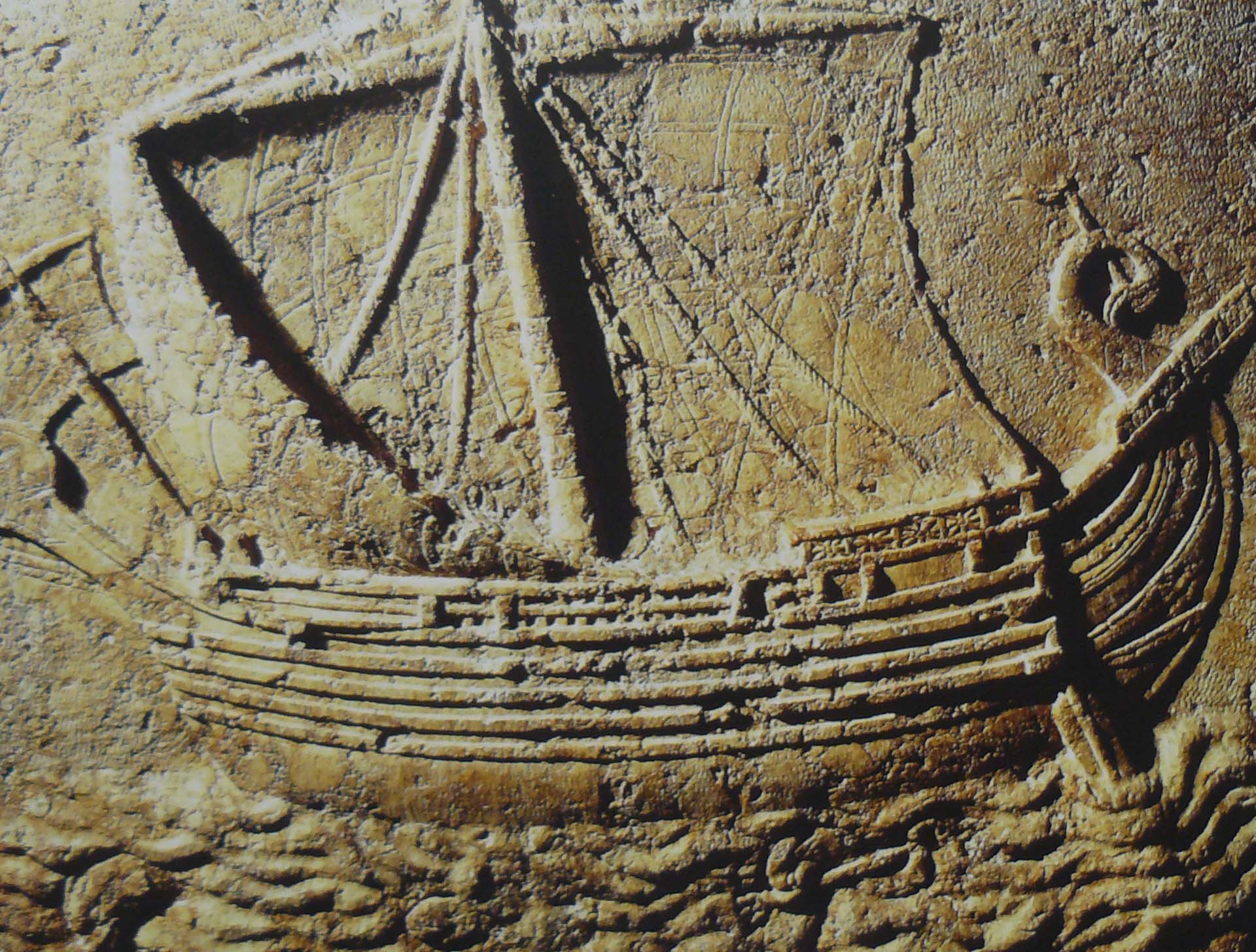
Phoenician_ship

In about the year 600 BC, he is said to have commissioned a group of Phoenicians to sail around Africa. According to Herodotus, they sailed east to west beginning from the Red Sea, south along the eastern coast and then north along the western coast of Africa. (No mention is made of rounding what we call the Cape of Good Hope.) They stopped each fall to plant crops to sustain them on their trip. They spent two years sailing around the continent and in the third year, returned through the Gates of Hercules to the Mediterranean and then made their way back to Egypt.

There is much controversy about this account, with many people doubting that it ever happened. But there is one line in the story by Herodotus that leads us to believe that it may have actually taken place.

In his story, Herodotus writes that as they traveled east to west, “they had the sun on their right” - to the north of them.

When people sail in the Mediterranean, the sun is to the south of them, because they are above the equator. So when they sail east to west, the sun would be to their left.

However, in that time, people thought that the earth was a flat disk, with the Mediterranean in the center and the countries around it, with all of it surrounded by the “river of ocean.” They had no concept of the earth being a sphere, with an equator. So they had no idea that the sun might be in a different position as you go below the equator.

Herodotus appears to have believed the story of the Phoenician expedition around Africa, but he doubted the idea that the sun could have been to their right as they sailed east to west. But this is the greatest evidence that these sailors did circumnavigate Africa over 2,000 years before the first Portuguese expedition by Bartolomeu Dias in 1488 which reached the Cape of Good Hope and entered the Indian Ocean, and the subsequent journey ten years later by Vasco da Gama, who led the first fleet around Africa to India.
An Odyssey of Epic Proportion

This is the second in a series of posts about historic travels.

The ancient Minoans were avid travelers, sailing from their base in Crete to various places around the eastern Mediterranean, from about 3000 to 1000 BC. We know this indirectly by evidence of the trade they conducted and artifacts they left in various places. Their coins have been found as far west as southern Italy and Sicily, and they may have even passed through the Strait of Gibaltar. But we have no direct written record of any particular voyage.

But we do have written record of one ancient voyager, named Ulysses. We have the story written by Homer, an epic voyage with a few detours, of Ulysses sailing home from Troy, “The Odyssey”. This story was put together from Greek stories, Minoan traditions, and myths from various peoples, handed down by word of mouth from generation to generation until Homer put them together and wrote them down. So it is not what we think of when we think of a traveler relating his experiences on a trip. There is no way to tell how much is true or based on truth and how much is pure fantasy. Homer knew little about geography or navigation, so there are many errors in these areas. But as a story of exploration and adventure, this one stands out.

I’m not going to give a synopsis of the book here. Nor am I going to try to trace the route of Ulysses on his journey, as this has been done many times, and all of the attempts have been based on conjecture and luck. But there are some places that we can determine as probable stops along the way.

messina

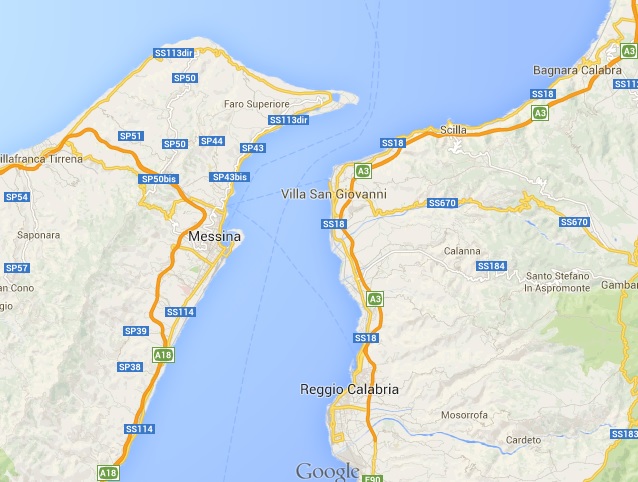
The “Scylla and Charybdis” almost certainly corresponds to the Strait of Messina between the island of Sicily and Calabria at the “toe” of Italy. The Scylla (a six headed serpent) is thought to correspond to a rock shoal on the Italian side of the strait and the Charybdis refers to a whirlpool off the coast of Sicily. Sailing between them could save considerable time as opposed to going around the island of Sicliy, but in those times it was a very big risk.

When Odysseus reached the Aeolian Islands, the Keeper of the Winds, gave Odysseus a tightly closed bag full of captured winds to use to easily sail home it Ithaca. However, his men opened it thinking it was full of riches, which ended up extending the voyage. The Aeolian Islands are located north of Sicily in the Tyrrhenian Sea, and are also known as the Lipari Islands because the largest island is named Lipari, as is its main town.

The Land of the Lotus Eaters is also easy to find. Along a portion of the coast of Tripoli, a form of the lotus was eaten and regarded as a delicasy.

Homer mentions Phoenicia, Cyprus and Egypt, but he appears to have a distorted view of the relationship of these places geographically. In his view, the Earth is a flat disk with the Mediterranean at its center and the countries forming its shores. Around them is the “river of ocean” that surrounds it all. Most of the rest of the world is full of mist and storms and monsters.

But Homer has a firm grasp of Ulysses as an explorer, adventurer and seaman. When things go against him and he cannot progress, he cries out and yearns to get home to Ithica. But once he has overcome whatever is holding himm back, he heads off in another direction for more exploration and adventure.

So while this may not be a straight forward description of one man’s travels, much of what is in this story is probably based on truth. Homer has given us one long traveler’s tail and a great travel story which can inspire the adventurer in all of us.

Egyptian Exploration, the First Recorded Journey

This is the first of a series of posts about historic travels. I will try to find interesting historical travel-related stories.

People have been traveling ever since there have been people. According to theory, people evolved in Africa and migrated to all other parts of the world. Trade occurred between people living in different parts of the world. People waged war against each other, sometimes having to travel long distances to do so. And I’m sure there were people who just decided to explore other places. And much of this happened before people developed a written language.

The first record of travel is from an Egyptian noble who went on a trading expedition for the pharaoh Mentuhotep III (Sankhkara) around 2750 B.C. The reason we know about him is because he was so proud of his accomplishment that he had an account of his travels carved in stone in the valley of Hammamat.

His name was Hannu and he is buried in a tomb in Deir el-Bahri, in Theban Necropolis (catalogued as TT313.)

Travels

With a three thousand man army for protection, Hannu set out in the eighth year of the reign of Mentuhotep III. It seems that the Egyptians had had dealings with people of Arabia previously, but Hannu revived this trade, which ultimately revived the fortunes of Egypt.
Hannu’s goal was to conduct ships to the land of Punt to fetch sweet-smelling spices for the king, who financed the expedition.

Hannu started out from the city of Coptos and traveled overland, over hills and across desserts, to a port he calls “Seba” somewhere along the Red Sea. This may have been at or near the current port city of Quseer (or Kosseir.) The description of this part of the journey includes a description of how they carried water with them and reservoirs he had built along the way to contain water.

boat

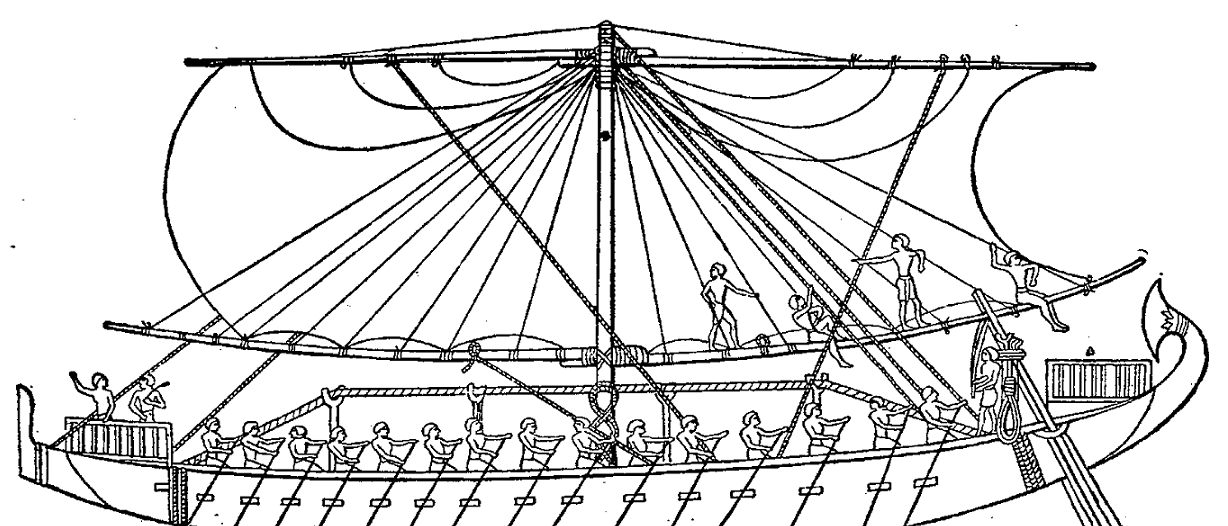
Once they arrived at Seba, he had ships built and offered animal sacrifices. At this point, he either sent the ships off to the Land of Punt or probably commanded them himself. They sailed south to get to the Land of Punt, which would have been somewhere around the Horn of Africa.

On his return from Seba, he brought with him 80,000 measures of myrrh, 6,000 weight of precious metal (gold-silver alloy) and 2,600 staves of precious wood, probably ebony. His inscription states that he returned “by the road of Uak and Rohan” and brought with him precious stones for the statues of the temples.

The trip that Hannu took was somewhere around 5,000 KM each way, around 3,000 miles. Not really a lot to us these days. The last trip I took to Europe included a flight from Philadelphia to Milan, about 6,600 KM or 4,000 miles each way. But his inscription goes on to boast that nothing like this had happened since the time of the sun-god RA, essentially meaning that nothing like this had ever happened before.

It’s quite possible that his boast was true.